CBSE School Compliance & Affiliation Support

CBSE Affiliation Guidance for New and Existing Schools

Structured, implementation-focused guidance across the full CBSE journey — legal entity and management readiness, land and building documentation, infrastructure and safety, staffing and records, SARAS application preparation, inspection readiness and deficiency correction.

Guidance led by professionals with more than 20 years of institutional experience.

What we support

What CBSE affiliation support covers

We support the areas that most commonly decide whether a school is ready to apply and to face inspection.

Legal entity & management

Society / trust / Section 8 readiness, object clauses and School Management Committee.

Land & building

Land title / lease, category mapping, building plan and completion documentation.

Infrastructure planning

Classrooms, laboratories, library, play area and barrier-free provisions.

Safety & mandatory approvals

Fire safety, building stability, water, sanitation and health certificates.

Staffing & records

Principal / PRT / TGT / PGT planning, service records and mandatory registers.

Website & public disclosure

Mandatory public disclosure readiness on the school website.

Application documentation

Organising affidavits, NOCs and supporting records for the SARAS application.

Inspection & deficiencies

Mock-inspection readiness and structured deficiency-response support.

Not one single route

Which CBSE situation are you in?

The steps, documents and timelines differ meaningfully between these cases. We first identify your situation, then map only what applies to you.

Opening a new school

Entity, land, building and infrastructure planning from the ground up.

State / local recognition

Preparing for state education-department recognition or NOC where applicable.

Applying for CBSE affiliation

Documentation, SARAS application and inspection readiness for fresh affiliation.

Upgrade / extension

Extending to senior secondary, adding sections or extending existing affiliation.

Correcting deficiencies

Structured response and rectification for existing schools facing compliance gaps.

Eligibility & readiness

Preliminary readiness (indicative)

The items below are indicative planning guidance. Exact requirements follow the applicable CBSE Affiliation Bye-Laws, current circulars, your category and state rules — confirm during a preliminary review.

Legal & management readiness

  • Registered society, trust or Section 8 company with education-enabling objects
  • School Management Committee constituted as per bye-laws
  • Land held by the entity through ownership or a long-term registered lease

Infrastructure & safety (indicative)

  • Classrooms, science and computer laboratories and a library
  • Adequate play area (on-campus or permissible nearby facility)
  • Fire safety, building-stability, water, sanitation and health certificates

Varies by category / state

  • Minimum land and built-up area differ by CBSE category (A / B / C)
  • Section capacity is now linked to certified built-up carpet area
  • State recognition / NOC requirements vary by state and local body
  • All indicative figures are subject to verification against current rules
Documentation

Documents generally required

  • Society / trust / Section 8 registration, MoA and bye-laws / rules
  • Land ownership or long-term registered lease documents in the entity’s name
  • Approved building plan and completion / occupancy certificate
  • Fire safety NOC and building-stability (structural) certificate
  • Water, sanitation / health and safe-drinking-water certificates
  • State recognition / NOC where applicable
  • Staff list with qualifications, appointment and salary records
  • Audited financial statements and funds-availability proof
  • Mandatory affidavits and School Management Committee resolution

Exact documents, formats and figures may change with CBSE circulars, your category and state rules. Treat this list as indicative and confirm against the current CBSE notification and SARAS instructions before applying.

Process

How CBSE affiliation typically progresses

A typical sequence for a fresh affiliation. Upgrades, extensions and deficiency cases follow a shorter, situation-specific path.

1

Feasibility & entity readiness

Situation mapping, category assessment and entity / land documentation checks.

2

State recognition (where applicable)

Preparing state education-department recognition or NOC where your state requires it.

3

Infrastructure & certificates

Aligning classrooms, labs, library and play area and obtaining mandatory safety certificates.

4

Documentation & public disclosure

Organising affidavits, records and mandatory public disclosure on the school website.

5

SARAS application

Preparing and organising the online application, built-up area certification and section calculation.

6

Inspection & compliance

Mock-inspection readiness, evidence folders and structured deficiency responses.

Common compliance risks we help you avoid

  • Incorrect built-up area certificate or wrong section calculation
  • Land title / lease or category selection that does not match the case
  • Missing mandatory certificates (fire, building stability, water, health)
  • Incomplete or inconsistent mandatory public disclosure on the website
  • Staffing or qualification gaps against expected norms
  • Applying in the wrong sequence across state recognition and CBSE
  • Unprepared infrastructure evidence at the time of inspection
Our role

How Legal SR Worlds assists

  • Identifying your exact CBSE situation and mapping only the steps that apply
  • Mapping current CBSE bye-laws, circulars and category norms to your project
  • Built-up area certification guidance and section-capacity calculation support
  • Documentation, affidavit and mandatory public-disclosure preparation
  • Assistance preparing and organising the SARAS application
  • Mock-inspection readiness, evidence folders and deficiency-response support
  • Ongoing compliance, extension and renewal guidance

Legal SR Worlds provides advisory, documentation and preparation support. Final approval, recognition, affiliation or registration remains subject to eligibility, documentation, inspection and the decision of the relevant authority.

Current norms (indicative)

CBSE land, play area & section norms

Summary of recent CBSE circulars, retained for planning. These figures and categories change over time — always confirm against the current CBSE notification and SARAS instructions before applying.

Last Updated: 19 Jan 2026 (Land) | 31 Jul 2025 (Sections)

Minimum Land Requirement

Source: CBSE Circular No. 04/2026 (19 Jan 2026)

Category Up to Secondary (Class X) Up to Senior Secondary (Class XII)
Category A 6,000 sq m 6,000 sq m
Category B 2,400 sq m 3,200 sq m
Category C 1,600 sq m 2,400 sq m
  • Plot: Contiguous land with boundary wall and building
  • Ownership/Lease: Land in name of Trust/Society/Section 8 Company; owned or long-term registered lease as per CBSE Bye-Laws and state rules
  • Category applicability: Category B/C as per CBSE definitions (state capitals, hilly areas, specified metros, NE/Islands etc.) — confirm your category during feasibility review

Play Area Requirement

  • On-campus: Minimum 2,000 sq m play area ideally within campus
  • Off-campus relaxation: Schools with land < 6,000 sq m may use nearby sports facilities (schools, colleges, stadiums) within 200 metres, provided safe access without crossing highways or major roads

Maximum Sections (Built-up Carpet Area)

Source: CBSE Circular No. 13/2025 (31 Jul 2025)

CBSE now determines maximum sections from total built-up carpet area, not land. Schools add 3 additional sections for every 400 sq m built-up area beyond base. Built-up area must be certified by local body or licensed architect.

Built-up Carpet Area Max Sections (Balvatika–Class XII)
1,000 sq m8
1,400 sq m13
1,800 sq m15
3,000 sq m24
5,000 sq m39
6,200 sq m48 (maximum cap)
Practical Notes: Exact category applicability depends on CBSE definition; verify during feasibility. Secondary and senior secondary sections must not exceed one-fourth of total sections running from Balvatika to Class 10.

Disclaimer: Final interpretation rests with CBSE / SARAS and applicable state/local authorities.

FAQ

Frequently asked questions

Is state recognition required before CBSE affiliation?
In many states a school first needs state education-department recognition or an NOC before applying to CBSE, but the requirement and sequence vary by state. We confirm what applies to your state during the preliminary review.
What land and building documents are generally reviewed?
Typically land ownership or a long-term registered lease in the entity’s name, an approved building plan, completion / occupancy certificate, and safety certificates (fire, building stability, water, sanitation). The exact land requirement depends on your CBSE category.
Can an existing school apply for an upgrade or extension?
Yes. Existing affiliated schools can apply for upgradation (for example to senior secondary), section increase or extension. The documents and steps differ from a fresh affiliation, which is why we map your specific case first.
What happens if our school has compliance deficiencies?
We help you review the deficiencies, organise a structured response and prepare rectification and evidence. Whether and how a deficiency can be corrected ultimately depends on CBSE’s assessment.
Are laboratory and library facilities required?
Yes. CBSE norms generally expect science and computer laboratories and a library, alongside classrooms and play area. The exact sizes and counts follow current bye-laws and your grade levels.
How are the number of sections decided now?
Recent CBSE circulars link maximum sections to the total built-up carpet area certified by the local body or a licensed architect, rather than to land area alone. Correct certification and calculation are important before applying.
Does consultancy guarantee affiliation?
No. We provide advisory, documentation and readiness support. CBSE affiliation is subject to the applicable bye-laws, current application requirements, state-level permissions, documentation, inspection and the decision of CBSE.
Can Legal SR Worlds help prepare for inspection?
Yes. We support mock-inspection readiness, evidence-folder and photo-plan preparation and post-inspection compliance responses, but we do not represent CBSE or control the inspection outcome.
Free learning

Relevant CBSE Masterclasses

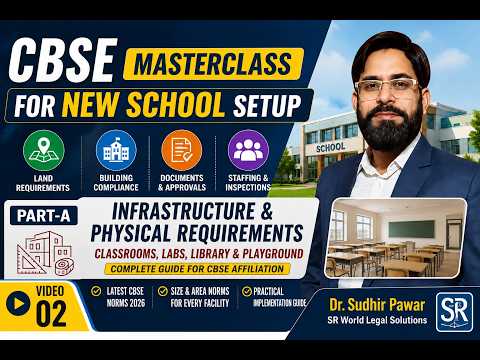
Free practical videos on land requirements, infrastructure and documentation for CBSE schools.
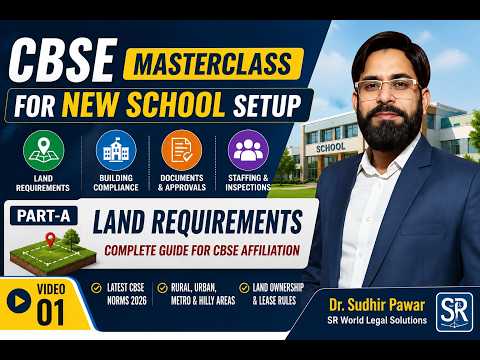
View all Masterclasses

Discuss Your School’s CBSE Affiliation Stage

Share whether you are opening a new school, seeking recognition, applying for affiliation, upgrading or correcting deficiencies. We will review your situation and outline the documentation, infrastructure and inspection steps that apply.

Preliminary reviews are guided by Dr. Sudhir Pawar and a team with more than 20 years of institutional experience.

Final approval, recognition, affiliation or registration remains subject to eligibility, documentation, inspection and the decision of the relevant authority. This page is informational and does not constitute a guarantee of outcome.
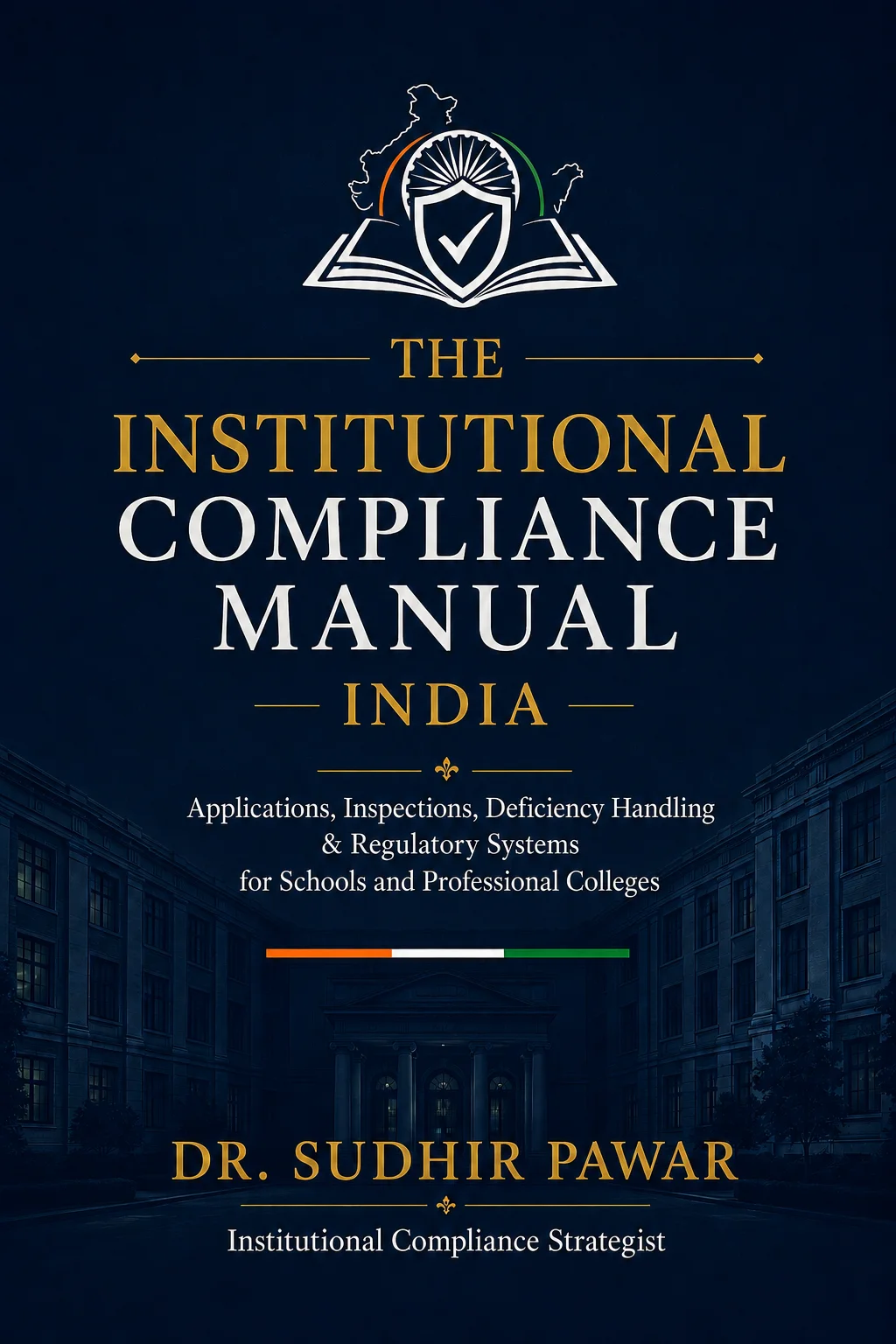
The Institutional Compliance Manual India book cover

Featured compliance resource

The Institutional Compliance Manual India

If you are exploring CBSE School Affiliation Guidance for New & Existing Schools, this manual helps you understand documentation readiness, governance records and recurring compliance routines.

Institution setup planning Approval-readiness checklists Compliance documentation

Written for Indian education and social-sector institution teams. Use it as a planning reference alongside current official notifications and professional advice.